
Surgeries
Minimal Invasive Spine Surgery
Conventional Spine Surgery involves taking long incisions, forceful muscle retraction for prolonged time, removal of normal tissues like ligaments and bone to approach area of pathology. Most of the times these surgeries are done under prolonged general anesthesia.
This long incisions and injury to normal structures results in
- Increased blood loss
- Increased scar tissue formation
- Increased chance of neural injury
- Epidural scarring
- Denervation of paraspinal muscles
- Delayed Mobility
- Longer Hospitalisation Stay
All these cause increased morbidity.
Minimal Invasive Spine Surgery involves
- Muscle Splitting Approach
- Minimal muscle retraction
- Less normal tissue damage
- Small Incision
- Less Blood Loss
- Early Mobilisation
- Preservation of muscle
- Paraspinal Muscle attachment preserved
- Less hospital Stay
- Targeted treatment of pathology
Advantages :
- Many surgeries are done under local anesthesia, hence surgeries can be done even in patients with high risk of anesthesia
- There is less blood loss
- Minimal morbidity
- Patient can be mobilized very early and he can be back to work faster
- It prevents complications associated with prolonged bed rest
- Less neural tissue damage
Since normal tissues are not removed or damaged, post operative pain is less and also there is less chance of failed back syndrome. To achieve these objectives many advanced instruments like Microscope, Endoscope, Radio-frequency and Laser spectal less tissue damaging retractions
Types
Precutaneous Endoscopic Lumbar Discectomy
This is unique type of surgery done for prolapsed intervertebral disc prolapse. This truly minimal invasive spine surgery. This surgery is done using YESS scope and done under local anesthesia with conscous sedation. Endoscope is passed under local anesthesia transforaminally in to affected disc and targeted fragmentectomy done. Wound is closed with single stitch. Patient is mobilized and can be discharged same day.
- Surgery done under local anesthesia with conscious sedation
- 5cm skin incision
- Endoscope used for surgery
- No muscle, ligament or normal tissue damage
- Targeted fragmentectomy (directly prolapsed disc tissue removed.)
- No blood loss
- Patient can be discharged same day
- No prolonged bed rest required after surgery. Can resume work sooner
- Even prolapsed, migrated, extraforaminal, recurrent discs can be removed
- Very good technique for old and medically compromised patients

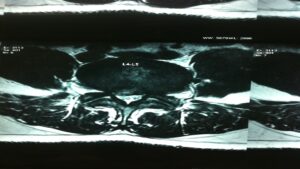
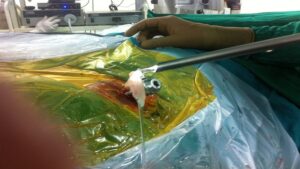


MED / METRx Tubular Retractor
- Technique similar to microdiscectomy
- Paramedian muscle splitting approach
- Serial Dilators used to split muscle without causing damage to muscle
- Magnification /illumination using microscope on endoscope
Advantages of Tubular Retraction
- Paramedian approach spaces muscle,muscle not detached for its attachments
- No muscle ischemia
- No muscle scanning
- Minimal bleeding
- Targeted treatment
MED / Microdecompression
Surgery Clone
- Useful in treating all types of disc prolapse
- Useful in intervertebral disc prolapse causing root compression with radiculopathy/sciatica
- Useful in lumbar canal stenosis where it has both leg pain
- Unilateral approach with bilateral foraminotomy
- Very minimal blood loss
- Same day mobilisation
- Discharge in 2-3 days
- Superior to microdiscectomy


Microdecompression for Lumbar Canal Stenosis with Unilateral Approach
Lumbar Canal Stenosis is commonest condition affecting older age group. In this condition size of lumbar canal is decreased due to disc degeneration, annular bulging, decreased in disc height, in folding of ligamentum flavum, facetal degeneration and osteophyte formation. Patient presents with leg pains/claudication on walking, neurological deficits and parasthesia and occasionally backache with stiffness.
Traditional surgical treatment of lumbar canal stenosis has been decompression by laminectomy, which gives good symptomatic relief however can cause morbidity due to instability and loss of posterior elements of spine, also can cause lots of epidural scarring.
Using Minimal Invasive Spine Surgical principals, we have been doing micro decompression of lumbar canal bilaterally using unilateral approach. This approach involves minimal normal tissue damage and at the same time achieves complete decompression of lumbar canal and foramen.
- 3 cm skin incision
- Operating microscope used for surgery
- Midline structures of spine like spinous process and ligaments preserved
- Complete decompression of neural tissue
- Patient can be mobilized earlier. No bed rest required post-operatively
- Short hospital stay
- Surgery can be combined with soft tissue stabilization techniques like ligamentoplasty
- No prolonged bed rest required after surgery. Can resume work sooner

SpS Microdecompression
In degenerative canal stenosis multilevel, without instability and with medical co-morbidities we prefer spinous process splitting microdecompression. This method of surgery is developed by us
- Spinous process split in middle without touching muscle attachment which is kept intact
- Decompression done using microscope
- Normal anatomy restored at end of surgery
- Muscle attachment preserved
- Fusion can be avoided
- Can also be combined with fusion surgery using cortical screws


Fusion MISS TLIF
Spinal fusion may be required for many pathologies causing instability of spine. In lumbar spine area, I have been doing posterior lumbar interbody fusion surgery using interbody cages with bone grafts and posterior stabilization using pedicle screw fixation.
With further refinement of surgical technique I have have been doing transforaminal lumbar fusion using minimal invasive technique. This technique preserves midline structures of spine, also reduces chances of epidural scarring.
Trans Foraminal Lumbar Fusion( MISS ):
- Fusion surgery done with help of microscope
- Midline structures preserved
- Complete decompression of nerve roots
- No epidural scarring
- Early post-operative recovery
- Less morbidity
Used in spinal pathologies regaining fusion
- Use of interbody cages & bone graff.
- Midline structures preserved.
- Percutanous screw fixation.
- Fixed tubular retractor used.
- 2.5 cm incision
- No blood transfusion.
- Same day mobilisation.
- Discharge on 3-4 days.
- Useful in revision/failed back surgery.
- No morbidity


Vertebroplasty
Osteoporotic compression fracture is very common occurrence in elderly even after trivial trauma. Inspite of adequate conservative treatment, pain of fracture persists. This can cause great morbidity and disability in elderly. I have been doing vertebroplasty under local anesthesia and IITV control. In this procedure special type of needle is inserted transpedicularly in to fractured vertebral body under local anesthesia and bone cement is injected. This bone cement after hardening supports fractured segment and pain is relieved. Since patient can be mobilized immediately, morbidity and complications associated with prolonged bed rest are reduced. Same technique is also used for metstatic bone fractures.
- Treatment method for osteoporotic compression fractures / also painful metastatic fractures
- Immediate pain relief
- Improves quality of life of elderly
- daycare procedure
In selected cases I do balloon kyphoplasty, where fractured compressed vertebra is expanded to restore height
Vertebroplasty


Vertebroplasty with Fixation


Kyphoplasty


Percutaneous Spinal Biopsy
Using same technique of vertebroplasty, spinal veretebral body biopsy can be done. These are done under local anesthesia.


Percutaneous Transpedicular Stabilisation
Advantages of percutaneous pedicle screws –
- Muscle preservation.
- Stabilisation of vertebres
- Multiple ting stab incision for pedicle screw and rod insertion
- C-arm guided procedure
- Paraspinal muscle preserved
- Immediate mobilisation
- Useful in fracture/deformity correction
When indicated I do minimal invasive, percutaneous pedicle screw fixation / stabilisation.


Cervical Spine Surgery
I commonly do Cervical Spine Surgeries for Cervical Disc Prolapse, Cervical Myelopathy, Cervical Trauma, Unstable Cervical Spine conditions using Minimal Invasive Spine Surgery principals.
Anterior cervical Fusion / Foraminotomy
- Surgery for spondylosis/radiculopathy
- Operating microscope used
- Small incision
- Less blood loss
Cervical posterior decompression
- Surgery for OPLL,cervical canal stenosis
- Combined with / without lateral mass screw fixation


MECD ( Micro Endoscopic Cervical Discectomy )
Minimal Invasive Technique applied to cervical spine surgery
- In selective case of cervical disc prolapse.
- Muscle splitting approach with serial dilators & Metrix Tube & Microscope
- Micro-foraminotomy done for prolapse disc / root canal stenosis
- Small incision 1.5 cm
- Preservation of paraspinal muscles.
- Minimal blood loss
- Immediate mobilisation.
- Hospital stay – 2 days.
- Preservation of normal disc & can avoid fusion surgery.


Empowering you with a healthy spine at Best Spine Clinic in Mumbai
Highly Experienced
Spine Specialists
Equipped with
Latest Technology
Multidisciplinary and
Holistic Approach
Need Expert Advise With Our Spine Doctor
Engage in a expert session with our experienced spine doctors to address your spinal health concerns and receive expert guidance tailored to your needs.
Frequently Asked Questions
To book an appointment at Nova Ortho Spine Center, you can visit our contact us page. there you will find information on how to schedule an appointment. You can also find the clinic’s location, hours of operation, and contact information.
Alternatively, you can also call the clinic’s mobile number 8425888801 and speak with a representative to schedule an appointment. You may need to provide some basic information such as your name, contact details, and the reason for your visit.
It’s recommended to check the availability of the doctors and the timings as per your convenience before booking an appointment.
Minimally invasive treatment options refer to procedures that use small incisions or specialized instruments to access the spine, rather than traditional open surgery. These procedures are designed to minimize the damage to surrounding tissue and result in less pain and faster recovery times for patients.
At Nova Ortho Spine Center, we do offer a variety of minimally invasive treatment options for conditions of the spine. Some examples of these include:
- Microdiscectomy: This is a surgical procedure used to treat a herniated disc in the lumbar (lower) spine. It is performed through a small incision, using a microscope to visualize the affected area.
- Endoscopic spine surgery: This type of surgery uses a small camera and specialized instruments to access the spine through small incisions. It is used to treat conditions such as spinal stenosis and herniated discs.
- Percutaneous laser disc decompression: This procedure uses a laser to treat herniated discs. A small incision is made, and a laser is inserted to vaporize the herniated portion of the disc.
- Vertebroplasty & Kyphoplasty : These are procedures used to treat vertebral fractures caused by osteoporosis or other conditions. A small incision is made, and a special cement is injected into the vertebral body to stabilize the fracture and reduce pain.
- Radiofrequency ablation: This is a non-surgical procedure in which a small needle is inserted into the spine and radiofrequency energy is used to disrupt the nerve impulses that are causing pain.
At Nova Ortho Spine Center, we strive to provide our patients with the most advanced and effective treatment options available. Our team of highly skilled and experienced spine specialists are well-versed in minimally invasive techniques and will work with each patient to determine the best course of treatment for their specific condition.
Success rates for spine treatments can vary depending on the specific condition being treated, the patient’s overall health, and the expertise of the treating physician. At Spine Clinic, we take pride in our high success rates for the treatments we offer.
It’s important to note that success rates can be difficult to measure, as they depend on a variety of factors and can be defined in different ways. Some patients may consider a treatment successful if it reduces their pain, while others may consider it successful if it improves their ability to function.
At Spine Clinic, we track our success rates for various procedures and treatments and use them to continually improve our care. We also encourage our patients to provide feedback on their treatment experiences, which can also be used to evaluate the success of our treatments.
However, it’s important to note that every patient is unique and the results can vary. Therefore, it’s recommended to consult with the specialists at Spine Clinic for more detailed and accurate information about the success rates for the treatment you are considering.
Yes, it is recommended to arrive early for your appointment at Nova Ortho Spine Center. Arriving early will give you time to fill out any necessary paperwork, review your medical history with the staff, and ensure that you are prepared for your appointment.
It also gives you time to relax and get familiar with the clinic’s environment before the appointment.
You may also want to bring a list of current medications you are taking, any medical records or imaging studies related to your condition, and your insurance card.
The recovery time after spinal surgery can vary depending on the type of surgery and the patient’s overall health. In general, more complex procedures and surgeries involving major spinal structures will have a longer recovery time.
For example, a lumbar microdiscectomy, a common surgery to treat a herniated disc in the lower back, typically has a recovery time of several weeks to a few months. Patients may be able to return to work and normal activities within a few weeks, but may need to avoid heavy lifting or strenuous activity for several months.
A spinal fusion surgery, which involves fusing two or more vertebrae together, typically has a longer recovery time. Patients may need to stay in the hospital for several days or a week, and may not be able to return to work or normal activities for several months.
Recovering from a minimally invasive procedure like endoscopic surgery or percutaneous laser disc decompression, may be faster with less pain and discomfort. However, it’s important to note that recovery time can vary depending on the patient’s condition, age and overall health.
It is important to discuss with your surgeon the estimated recovery time and post-surgery instructions after the surgery. Your surgeon will also give you instructions on when you can start physical therapy, which will help you regain your strength and mobility.
We will recommend you to do your own research, speak with your doctor and consider factors such as the qualifications and experience of the physicians, the types of treatments offered, the clinic’s success rates, and patient reviews. Nova Ortho Spine Center is one of the best spine clinics in Mumbai, known for their team of highly skilled and experienced spine specialists and providing a wide range of treatment options.
It is recommended to see a spine surgeon or visit a spine clinic if you are experiencing any persistent symptoms of a spine problem such as:
- Chronic or severe back pain or neck pain
- Numbness or tingling in the arms, legs, or hands
- Weakness in the arms, legs, or hands
- Stiffness in the back or neck
- Limited range of motion in the back or neck
- Loss of bladder or bowel control
- Radicular pain that radiates from the spine to the arms or legs
- Myelopathic symptoms such as difficulty walking, loss of balance, and weakness in the legs
- Visible deformity of the spine such as scoliosis
- Failure of conservative treatments such as physical therapy, medication, or epidural injections
- Symptoms that interfere with daily activities or your quality of life
It’s important to note that these symptoms may be caused by other conditions as well, so a proper diagnosis from a qualified spine specialist is important. Even if your symptoms are mild and not debilitating, if you have a family history of spine problems or certain risk factors such as a sedentary lifestyle, smoking, or obesity, it’s a good idea to consult a spine specialist for an evaluation.